
Deep Plane Facelift
A deep plane facelift repositions the deeper tissues of the face to address sagging of the cheeks, jawline, and neck while preserving natural facial expression. This approach is also known as a preservation face lift, because it keeps the skin attached to the tissues beneath it and lifts them together. Dr. Amani Obeid performs deep plane facelift surgery in Riyadh. Each plan is made after your consultation, based on your facial anatomy and what you would like to change.
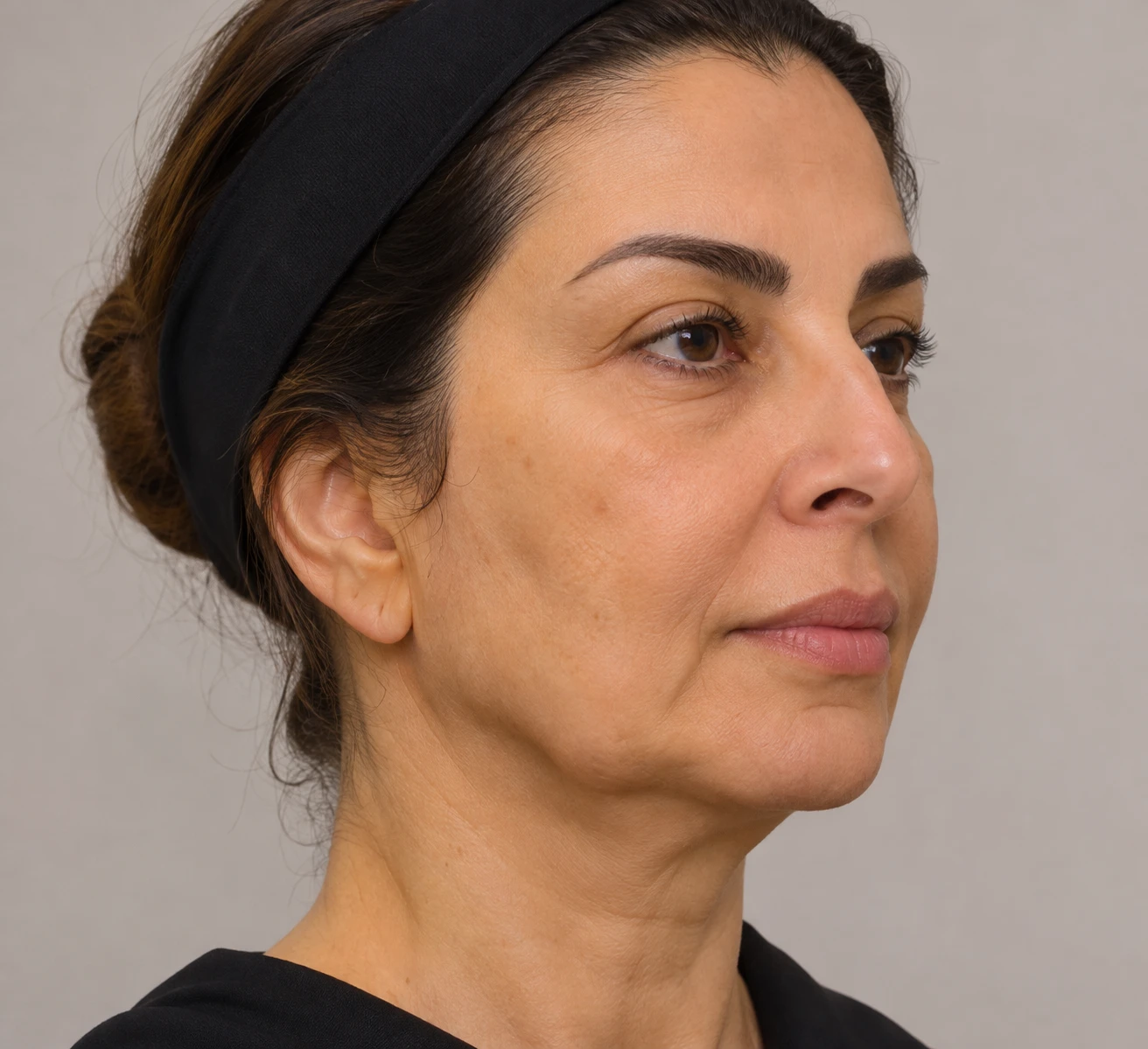
- Anesthesia
- General
- Length of surgery
- Three hours
- Hospital stay
- Usually one night
- Back to work
- Two to three weeks
- Result settles
- Three to six months
What a deep plane facelift can address
A deep plane facelift treats sagging tissue, not the quality of the skin. Other procedures may be added to it when needed.
- Cheeks and midface
- Lifting sagging cheeks and returning fullness to where it belongs.
- Lines around the mouth
- Softening the deep folds that run from the nose to the corners of the mouth.
- Jawline
- Restoring definition to the jawline and treating sagging along its sides.
- Neck
- Tightening loose skin of the neck and under the chin, often together with a neck lift in the same operation.
- What it does not treat
- Fine lines and skin quality, and the eyelids and forehead, which have their own procedures.
Procedures added to a facelift
Additional procedures are often needed with a facelift to achieve full rejuvenation and a harmonious look, such as a brow lift, eyelid surgery, facial fat grafting, and others.
These are decided during your consultation, based on what your face needs, and are usually performed in the same operation.
Who is a candidate
A deep plane facelift suits people with clear sagging of the cheeks, jawline, and neck that non-surgical treatments cannot correct. Age is not the measure. The condition of the tissues is.
Good general health is essential. Smoking raises the risk of wound-healing problems, so you will be asked to stop before and after surgery.
The aim is a face that looks rested and younger and still familiar to you and to those around you. Surgery does not change your features, and it does not stop natural aging.
How deep plane differs from a traditional facelift
Working beneath the muscle layer
The lift is performed beneath the SMAS, the layer of muscle and connective tissue under the skin, so the deeper tissues and the skin are lifted together as one unit.
Releasing ligaments
Selected ligaments that hold the cheeks in their sagging position are released, which allows the midface to be lifted, not only the jawline.
No tension on the skin
The tension is carried by the deep layer, not by the skin, so the skin is closed without pull. This is what keeps the result natural and avoids a tight look.
The day of surgery
Surgery is performed in the hospital under general anesthesia. It usually takes about three hours, and longer when other procedures are added.
The incisions are hidden around the ear and within the hairline. At the end of surgery a dressing is placed around the face, and a small drain may be used and removed within a day or two. Most patients stay one night in the hospital.
Recovery
Recovery varies from person to person. This is a general picture of what to expect.
Week one
Swelling, bruising, and a feeling of tightness and numbness in the face and neck. Stitches are removed within seven to ten days.
Two to three weeks
Bruising fades, and most patients return to work and social occasions.
Four to six weeks
A gradual return to exercise, following Dr. Obeid’s instructions.
Three months
Most of the swelling has settled and sensation gradually returns.
Six months to a year
The result settles, and the scars mature and fade.
Risks and limitations
Like any surgery, a facelift carries risks. They include a collection of blood under the skin, infection, temporary weakness of a branch of the facial nerve (permanent weakness is rare), numbness around the ear, visible scars, hair loss along the incisions, and asymmetry.
Dr. Obeid explains these possibilities clearly during your consultation, along with what is done before and after surgery to reduce them.
Your surgeon
Deep plane facelift surgery is performed by Dr. Amani Obeid, a consultant facial plastic and reconstructive surgeon in Riyadh. She holds the International Board Certification in Facial Plastic and Reconstructive Surgery (IBCFPRS), completed two fellowships in the United States, and limits her practice to surgery of the face and neck.
Common questions about deep plane facelift
How does a deep plane facelift differ from a traditional facelift?
In a deep plane facelift, the tissues are released beneath the SMAS and repositioned as one unit, rather than relying on tightening the skin. This allows the midface, jawline, and neck to be improved without a tight look.
How long do the results last?
The result lasts for many years, but the face continues to age naturally. How long depends on the quality of your skin and your lifestyle.
Where are the scars?
The incisions are hidden around the ear and within the hairline. The scars fade gradually over the first months and are usually hard to see once they have matured.
Can a neck lift or eyelid surgery be done in the same operation?
Yes. A neck lift is performed with a facelift in many cases, and a brow lift, eyelid surgery, or facial fat grafting is often added to achieve a harmonious look.
When can I return to work?
Most patients return to work and social occasions within two to three weeks.
Will I look different?
The aim is for you to look like yourself, with a face that is rested and better defined. Avoiding a tight look is a central part of planning the operation.
The plan starts with a conversation
Dr. Obeid sees patients at two locations in Riyadh. To book a consultation or ask a question, contact your preferred clinic on WhatsApp.
Clinic hours
- Tuesday and Wednesday
- 4 to 8 pm
Al Safwa Majesty Hospital
Abdulrahman bin Ali Al Alsheikh Street, Riyadh