
Forehead Reduction and Hairline Lowering
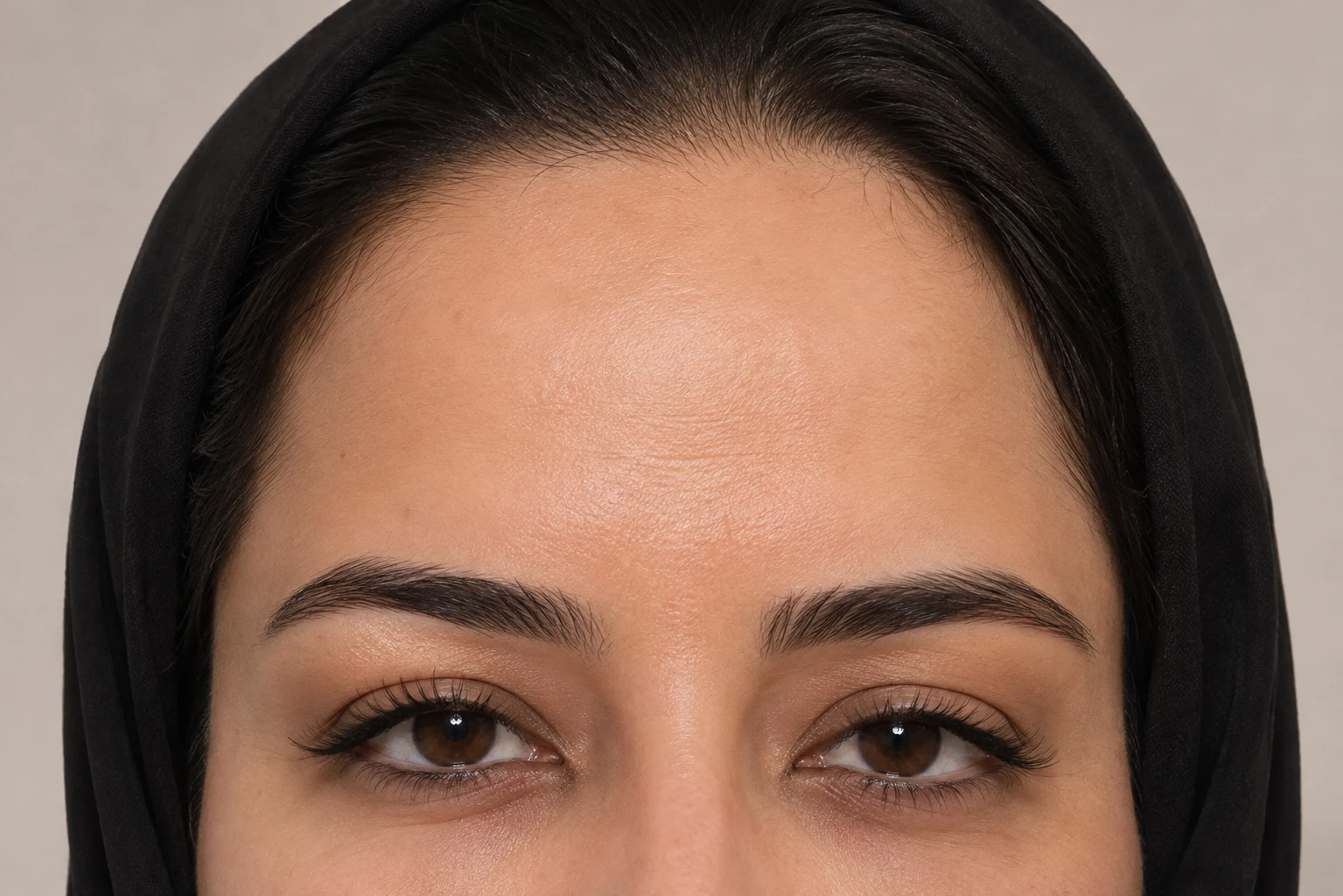
Forehead reduction, also known as hairline lowering or surgical hairline advancement (SHA), shortens a high forehead by bringing the hairline closer to the brows. The aim is better balance between the parts of the face, respecting your proportions and the natural shape of your hairline. Dr. Amani Obeid performs forehead reduction in Riyadh, and each plan is made after your consultation, based on the shape of your forehead and hairline and what you would like to change.
- Anesthesia
- General, or local with IV sedation
- Length of surgery
- One to two hours
- Stitches out
- Within seven to ten days
- Back to work
- One to two weeks
- When the scar improves
- Six months to a year
What forehead reduction can address
A high forehead is mostly inherited, and it can make the face look longer or out of balance.
- A high forehead
- Reducing the distance between the brows and the hairline.
- The hairline
- Redefining the hairline in a natural shape that suits the face.
- A low brow with a high forehead
- The brow can be lifted in the same operation, through the same incision.
- What it does not treat
- A receding hairline or ongoing hair loss, and a prominent forehead bone.
Who is a candidate
Forehead reduction suits women with a naturally high forehead, dense hair at the hairline, and a scalp flexible enough for the hairline to be brought down.
It may suit a small number of men, provided there is no inherited hair loss in the patient or the family, so that the scar does not become visible if the hairline recedes later.
You should not have active hair loss, because the new hairline depends on stable hair at the hairline and on hair growing through the scar.
If the hairline is receding or the hair is thinning, a hair transplant may suit you better. Dr. Obeid explains this during your consultation.
Scalp flexibility is measured during the examination, and it decides how far the hairline can be lowered in one operation.
How the surgery is done
The incision
A fine, irregular incision is made along the hairline, so that hair grows through the scar over time and hides it.
Lowering the hairline
The scalp is released and brought forward, and the excess forehead skin is removed.
Fixing the scalp
The scalp is fixed to the bone in its new position, which keeps the scar from widening.
Closure
The incision is closed carefully with fine cosmetic stitches and without tension, for a fine scar.
Forehead reduction can be combined with a brow lift.
The day of surgery
Surgery is performed under general anesthesia, or local anesthesia with IV sedation. It usually takes one to two hours, and longer when combined with a brow lift.
Most patients go home the same day, with a dressing around the head that is removed the next day or soon after.
Recovery
Recovery varies from person to person. This is a general picture of what to expect.
First days
Swelling of the forehead, which may settle around the eyes, with tightness and numbness in the scalp.
Seven to ten days
Stitches are removed.
One to two weeks
Most patients return to work, and the hairline can be hidden with a hairstyle.
Three months
Most of the swelling has settled, sensation gradually returns, and hair begins to grow through the scar.
Six months to a year
The scar gradually fades as hair grows through it, and the result settles.
Risks and limitations
Like any surgery, forehead reduction carries risks. They include bleeding, infection, temporary numbness of the scalp, temporary hair shedding near the incision, a visible scar in some patients, and asymmetry.
The flexibility of your scalp decides how far the hairline can be lowered, and for some patients one operation may not be enough. Dr. Obeid explains these possibilities clearly during your consultation.
Your surgeon
Forehead reduction is performed by Dr. Amani Obeid, a consultant facial plastic and reconstructive surgeon in Riyadh. She holds the International Board Certification in Facial Plastic and Reconstructive Surgery (IBCFPRS), completed two fellowships in the United States, and limits her practice to surgery of the face and neck.
Common questions about forehead reduction
Will the scar show?
The incision follows the hairline in an irregular line, and hair grows through it over time, so once it has matured the scar is usually hidden in the hair.
How far can the hairline be lowered?
That depends on the flexibility of your scalp, and is decided during the examination at your consultation.
Can forehead reduction be combined with a brow lift?
Yes. If the forehead is high and the brow is low, the brow can be lifted through the same incision in the same operation.
How does it differ from a hair transplant?
Forehead reduction lowers the hairline in one operation with an immediate result, and suits a naturally high forehead. A hair transplant suits a receding hairline or thinning hair better.
When can I return to work?
Most patients return to work within one to two weeks.
When can I dye my hair?
Hair dye should be avoided for four to six weeks after surgery, to prevent permanent pigmentation (tattooing) of the scars.
Is the result permanent?
Yes. The new hairline is permanent, unless the hair recedes later for other reasons.
The plan starts with a conversation
Dr. Obeid sees patients at two locations in Riyadh. To book a consultation or ask a question, contact your preferred clinic on WhatsApp.
Clinic hours
- Tuesday and Wednesday
- 4 to 8 pm
Al Safwa Majesty Hospital
Abdulrahman bin Ali Al Alsheikh Street, Riyadh