
Otoplasty
Prominent Ear Correction and Ear Reduction
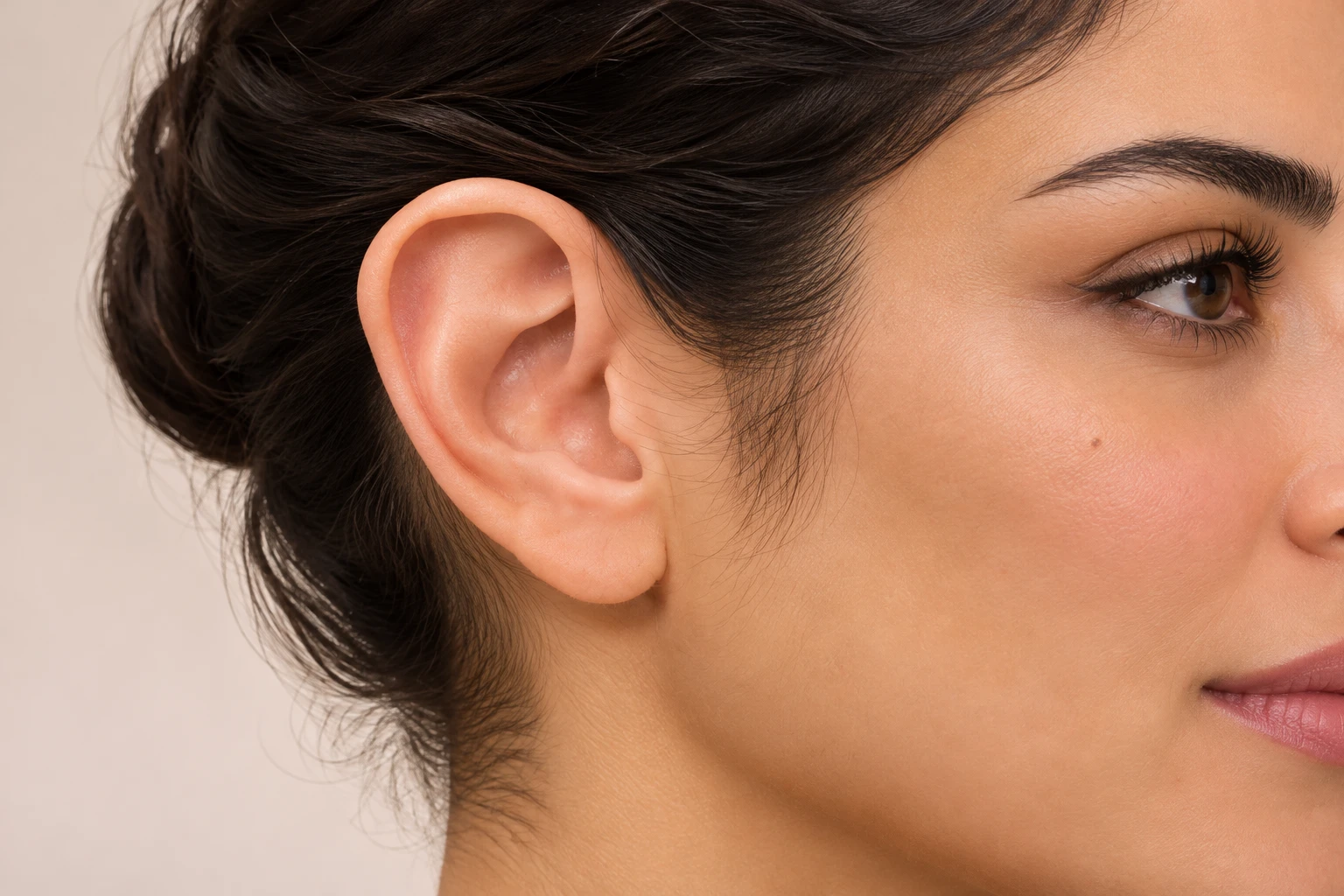
Otoplasty reshapes the ear cartilage and sets prominent ears closer to the head, improving their balance with the face while keeping a natural look. It treats prominent ears, sometimes called bat ears, and can also reduce large ears. Dr. Amani Obeid performs otoplasty in Riyadh for children and adults, and each plan is made after your consultation, after studying the shape of the ears and what you would like to change.
- Anesthesia
- General, or local with IV sedation
- Length of surgery
- One to two hours
- Headband
- At night for several weeks
- Back to work or school
- About one week
- Result settles
- Three months
What otoplasty can address
Prominent ears are usually present from birth, and come from the shape or size of the cartilage rather than the ear itself.
- Prominent ears (bat ears)
- Setting the ear closer to the head at a natural angle.
- Missing natural ear folds
- Recreating the natural folds of the ear cartilage when they are absent or weak.
- A deep ear bowl
- Reducing a deep central bowl of the ear that pushes it outward.
- Asymmetry between the ears
- Improving the match between the two ears as far as possible.
- Large ears
- Ear reduction is possible in some cases.
- What it does not treat
- Hearing loss. Surgery does not change how the ear works.
Who is a candidate
For children, otoplasty can be done at any age, but it is usually preferred between four and six years, to avoid bullying at school. It also suits teenagers and adults.
In children, it is best when the child wants the surgery and can follow the instructions afterwards.
Patients should be in good general health, without an active ear infection.
How the surgery is done
The incision
An incision is made behind the ear, in the natural crease between the ear and the head, so it does not show from the front.
Reshaping the cartilage
The cartilage is reshaped with permanent stitches to recreate the natural folds of the ear, and the ear bowl is reduced when needed.
Closure and dressing
The incision is closed with fine cosmetic stitches, and a dressing is placed around the head to protect the ears.
The day of surgery
Surgery is performed under general anesthesia for children, and under general anesthesia or local anesthesia with IV sedation for adults. It usually takes one to two hours.
Most patients go home the same day, with a dressing around the head that is removed within days. A headband is then worn at night for several weeks.
Recovery
Recovery varies from person to person. This is a general picture of what to expect.
First days
Mild pain, swelling, and a feeling of tightness in the ears, controlled with simple pain relief.
Week one
The dressing is removed, and most patients return to work or school.
Several weeks
A headband is worn at night to protect the ears during sleep.
Four to six weeks
A gradual return to sport, avoiding activities where the ear could be struck for longer.
Three months
Most of the swelling has settled and the result is stable.
Risks and limitations
Like any surgery, otoplasty carries risks. They include bleeding and a collection of blood, infection, temporary changes in sensation, slight asymmetry, partial return of prominence, stitches that can be felt under the skin, and thickened scars in some patients.
Ears are never exactly identical by nature, and the aim is a balanced pair with a natural look. Dr. Obeid explains these possibilities clearly during your consultation.
Your surgeon
Otoplasty is performed by Dr. Amani Obeid, a consultant facial plastic and reconstructive surgeon in Riyadh. She holds the International Board Certification in Facial Plastic and Reconstructive Surgery (IBCFPRS), completed two fellowships in the United States, and limits her practice to surgery of the face and neck.
Common questions about otoplasty
What is the best age for otoplasty?
It can be done at any age, but for children it is usually preferred between four and six years, to avoid bullying at school.
Can otoplasty make large ears smaller?
Yes, ear reduction is possible in some cases. Dr. Obeid assesses this during your consultation.
Will the scar show?
The incision is made behind the ear in its natural crease, so it does not show from the front.
Does the surgery affect hearing?
No. Surgery is performed on the cartilage of the outer ear and does not touch the inner ear or hearing.
How long is the headband worn?
At night for several weeks, following Dr. Obeid’s instructions after surgery.
Is the result permanent?
Yes, in most cases. A small number of patients may see some prominence return.
The plan starts with a conversation
Dr. Obeid sees patients at two locations in Riyadh. To book a consultation or ask a question, contact your preferred clinic on WhatsApp.
Clinic hours
- Tuesday and Wednesday
- 4 to 8 pm
Al Safwa Majesty Hospital
Abdulrahman bin Ali Al Alsheikh Street, Riyadh