
Rhinoplasty
Rhinoplasty reshapes the bone and cartilage of the nose to improve its shape and its balance with the rest of the face. Breathing problems can be treated in the same operation. Dr. Amani Obeid performs rhinoplasty in Riyadh, and each plan is made after your consultation, based on the anatomy of your nose, your facial features, and what you would like to change.
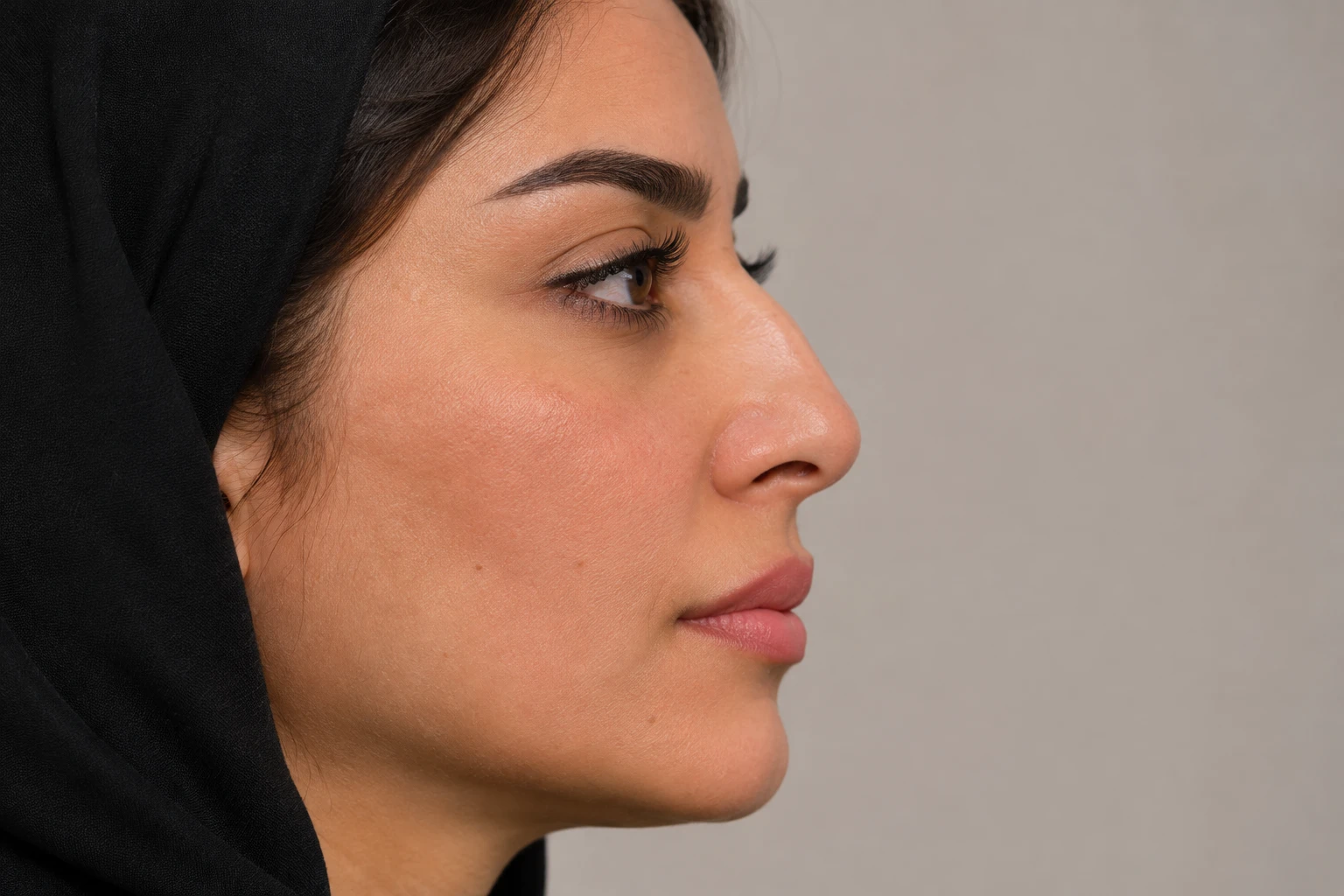
- Anesthesia
- General
- Length of surgery
- Two to three hours
- Splint
- About one week
- Back to work
- One to two weeks
- Final shape
- About one year
What rhinoplasty can address
No single operation suits every nose. The steps depend on what the examination shows and what you would like to change.
- Nasal bridge
- Reducing a hump or adjusting the height of the bridge.
- Nasal tip
- Refining a wide tip, or lifting and supporting a drooping one.
- Deviation and asymmetry
- Straightening a crooked nose, whether from an injury or present since birth.
- Width
- Narrowing the nasal bones or the nostrils when needed.
- Length and angle
- Adjusting the length of the nose and its angle with the upper lip.
- Breathing
- Correcting a deviated septum and opening the airway in the same operation.
Who is a candidate
Rhinoplasty suits people whose nose has finished growing, who are in good general health, and who have a specific concern about the shape of their nose or their breathing.
Realistic expectations are part of a good result. The aim is a nose that suits your face and looks natural, not a copy of someone else’s.
Dr. Obeid may advise waiting, or advise against surgery, if the change you are asking for would not serve your face or cannot be achieved safely.
How surgery is planned
Examination
Dr. Obeid examines the nose inside and out: the bone and cartilage, the septum and the airway, and the thickness of the skin. Her specialty training in ear, nose, and throat surgery makes breathing part of every plan.
Photographs and discussion
Standard photographs of your face are taken. You then discuss what can be changed, what is better left alone, and the limits set by the structure of your nose.
Choice of technique
Surgery is performed with an open or a closed approach, depending on your case, and cartilage may be used to support the nose. Preservation rhinoplasty is also an option when it suits the nose: an approach that keeps the natural nasal bridge and its ligaments rather than removing and rebuilding it. Thicker skin, which is common in our region, needs stronger tip support and more time before fine detail shows.
The day of surgery
Rhinoplasty is performed in the hospital under general anesthesia. It usually takes two to three hours, depending on what your case requires.
At the end of surgery an external splint is placed on the nose, and soft internal splints may be used. Most patients go home the same day or after one night.
Recovery
Recovery varies from person to person. This is a general picture of what to expect.
Week one
Swelling, bruising around the eyes, and a blocked nose. The splint is removed after about a week.
Week two
Bruising fades, and most patients return to work and light daily activities.
Four to six weeks
A gradual return to exercise, following Dr. Obeid’s instructions.
Three months
Most of the swelling has settled and the overall shape of the nose is clear.
About one year
The final shape settles. It can take longer with thicker skin or after revision surgery.
Risks and limitations
Like any surgery, rhinoplasty carries risks. They include bleeding, infection, difficulty breathing, asymmetry, temporary numbness of the skin of the nose, and dissatisfaction with the shape.
A small number of patients need revision surgery later. Dr. Obeid explains these possibilities clearly during your consultation, along with what can be done to reduce them.
Your surgeon
Rhinoplasty is performed by Dr. Amani Obeid, a consultant facial plastic and reconstructive surgeon in Riyadh. She holds the International Board Certification in Facial Plastic and Reconstructive Surgery (IBCFPRS), completed two fellowships in the United States, and limits her practice to surgery of the face and neck.
Common questions about rhinoplasty
Can rhinoplasty improve breathing?
Yes, it can. If the examination shows a deviated septum or weak nasal support, it is corrected in the same operation as the change in shape.
Is rhinoplasty painful?
Most patients describe the first few days as uncomfortable rather than painful, because of congestion and swelling. Pain is usually controlled with simple pain relief.
What is the difference between open and closed rhinoplasty?
In the open approach, a small incision is added across the column of skin between the nostrils, which gives a direct view of the cartilage. In the closed approach, all incisions are inside the nose. Dr. Obeid chooses the approach based on what your nose needs.
Will there be a visible scar?
The closed approach leaves no external scar. The open approach leaves a fine line under the nose that fades with time and is usually hard to see.
When can I return to work?
Most patients return to work within one to two weeks, once the splint is off and the bruising has faded.
When will I see the final result?
Most of the swelling settles within the first three months. The final shape settles over about a year, and it can take longer with thicker skin or after revision surgery.
The plan starts with a conversation
Dr. Obeid sees patients at two locations in Riyadh. To book a consultation or ask a question, contact your preferred clinic on WhatsApp.
Clinic hours
- Tuesday and Wednesday
- 4 to 8 pm
Al Safwa Majesty Hospital
Abdulrahman bin Ali Al Alsheikh Street, Riyadh